
Flaming June
'Adlestrop' by Edward Thomas; The Croquet Player by HG Wells.

Well, there’s been quite a gap between my first post and this one… As I mentioned last time, part of why I’m writing this Substack is to push myself to read more and scroll less. But to be fair to myself, the past month has been relentlessly busy so whilst I’ve still been doing quite a bit of scrolling I’ve also genuinely had less time than usual. So I’m not going to put myself on the naughty step. Not yet anyway.
The heat wave of the past few days hasn’t helped my reading much either. Flaming June has been, well, flaming sticky, hasn’t it? It’s been hard to concentrate on anything, though my husband’s last minute purchase of an air conditioner (thank you to him for tracking one down!) has meant that at least the room I work in upstairs has been pleasant. One positive aspect of scrolling has been that I’ve been thinking about where the phrase Flaming June comes from. Down the internet rabbit hole I fell like a sort of zombie Alice in Internetland and ended up stumbling upon images of ‘Flaming June’ by the painter Sir Frederic Leighton. I love art so I’ve zero idea how I’ve never come across this painting before but I think it’s stunning. Here’s a link here to one of the more interesting articles I found about it: www.metmuseum.org/perspectives/flaming-june
But anyway, back to literature. Below are a couple of the texts I’ve been reading over the past couple of weeks. I’ve chosen a poem (because I think everyone has time to read a poem whilst their cuppa’s brewing!) and a lesser-known novella by a well-known writer. I promise you, you really can find time for these two in your busy schedule.

‘Adlestrop’ by Edward Thomas
I tend to have some seasonal rituals when it comes to literature and one of these is to purposely reads texts linked to whatever time of year it is. Somehow it makes me feel more connected to the world around me and appreciate the seasons a little more. I also like the feeling of warm familiarity it gives me. ‘Adlestrop’ is one of those seasonal texts I return to year after year. I could talk and write all day about this poem - to me, it’s exquisite, though perhaps hard to write about because the atmosphere it conveys and the feelings created really are quite difficult to put into words, or for me, anyway.
Total honesty here: I have a lot of affection for old railway stations, pre-Beeching cut lines and ‘bygones’. I know, I know, a lot of it is just nostalgia (or sort of nostalgia for me as I wasn’t even born in those days so it’s more like imagination) and the reality was almost certainly more like soot and dirt and rackety old coaches. I’m one of those people who lurks in ‘Old Railways’ FB groups and looks at old photos of immaculate rural stations which are placed side by side with their later abandoned 1970s shells and followed by pictures of their reincarnations as smart homes with smart gardens on Rightmove. So you can easily see why I absolutely love this poem. But it’s not just that: even if old railway stations aren’t your thing, Adlestrop satisfyingly draws you into another time and place and like the best literature, it touches on emotions that are otherwise hard to express.
Here’s a link to the poem, if you don’t have it to hand: https://www.poetryfoundation.org/poems/53744/adlestrop
Straightforwardly, the writer is on a train journey and stops unexpectedly at Adlestrop station. It’s a hot afternoon in late June; we don’t know where he’s going but that doesn’t matter because it’s the brief stop at this small, provincial station that he remembers - and we will too.
I love the opening lines: ‘Yes. I remember Adlestrop’. Opening a poem as though the poet is half-way through a conversation with you or you’re halfway through the action is appealing - you’re quickly drawn in and I love it when writers do this. Or maybe in this instance, he’s really just talking to himself?
I’m particularly enamoured of the second stanza:
‘The steam hissed. Someone cleared his
throat.
No one left and no one came
On the bare platform. What I saw
Was Adlestrop - only the name’
To me, the short sentence of ‘The steam hissed’ emphasises the end of motion as well as the harsh heat; it’s then contrasted with this wonderful sense of stillness, quiet and calm. It’s a precious moment in time - as Thomas tells us: ‘No one left and no one came’ - the busyness of life is suspended in this pleasant, gentle country place.
Thomas then goes on to describe the natural world surrounding this station - the list of plants in the third stanza with the ‘willows, willow-herb, and grass’ seems to emphasis a sense of a perpetual summer, an everlasting time and place.
By the final stanza, the writer imagines the countryside stretching across ‘Oxfordshire and Gloucestershire’. There are a multitude of interpretations of this poem but for me it’s inviting us to not only appreciate the countryside but to appreciate life itself - the small moments and the sense of being alive.
It’s tricky to really convey how the poem makes me feel. It’s a moment in time; the beauty of the natural world; a moment of calm. I’d recommend taking a moment out of your day and reading the poem through for yourself.
Ironically, despite now being such a well-known location, Adlestrop station was closed in the 1960s, a typical victim of the Beeching cuts - apparently all that remains is one of its signs which was saved and moved to a nearby bus stop.
The first world war began just a few months after ‘Aldlestrop’ was written and Edwards killed in action just under three years later. That fact alone makes this poem not only beautiful but also very poignant.
Why it’s worth finding a reading window for ‘Adlestrop’…
That precious moment in June couldn’t last forever, but the power of literature being what it is, that stop at Adlestrop has somehow lived on. It’s a beautiful, poignant poem: a reminder to appreciate hot summer days in June and a bit of escapism for a minute in your busy day.
The Croquet Player by H G Wells
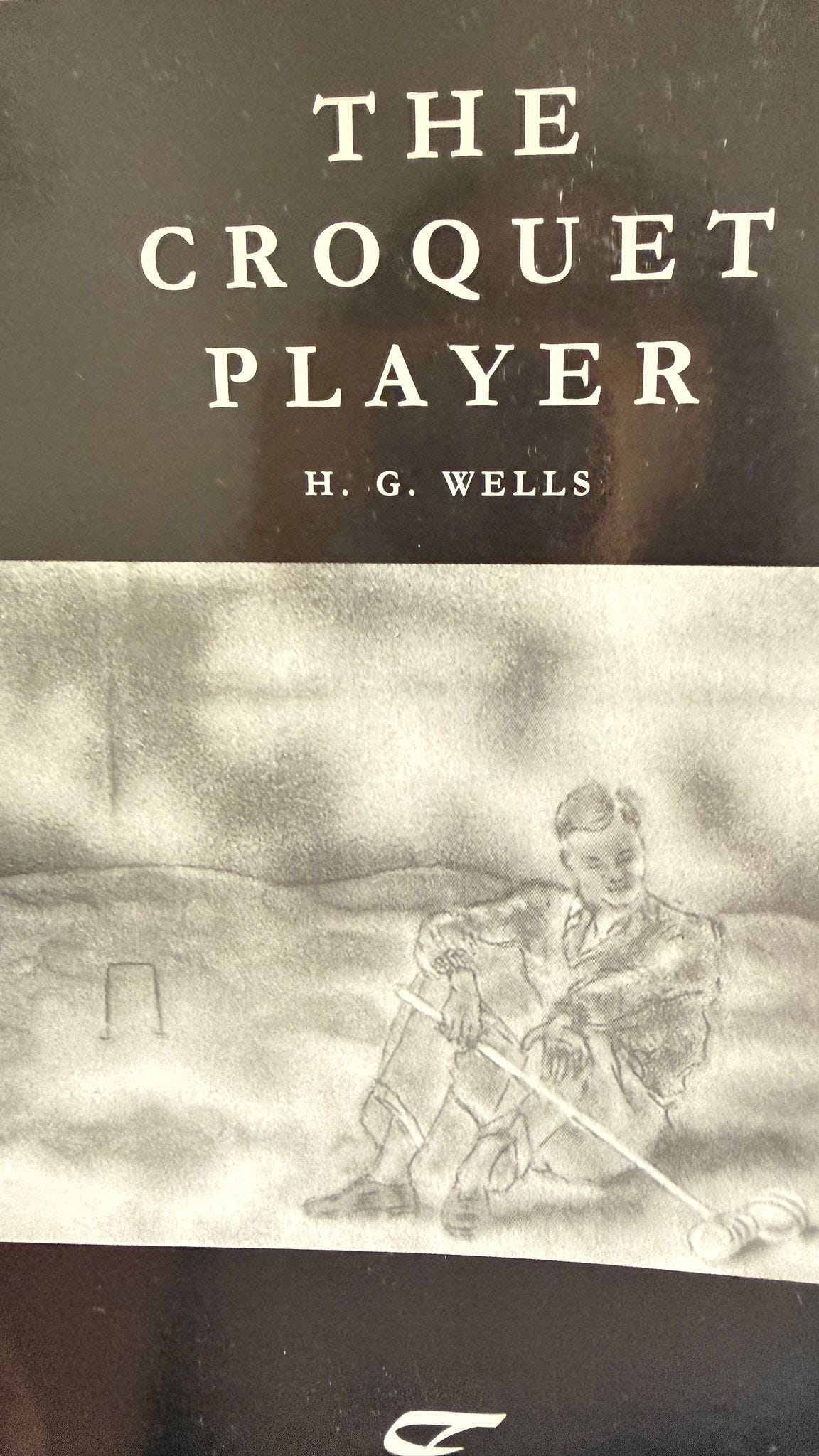
Like many people, and probably you too, I mainly associate Wells with famous books like The Time Machine and The War of the Worlds (I will confess that whilst I usually prefer to read a book before I watch the film of it, The War of the Worlds is a rare example of me watching a film version first and then reading it afterwards - I liked it so much that I even used part of it as part of a short science fiction scheme of work I created when I was an English teacher but maybe more of that another time). So basically, that was all I’d previously read of Wells until last week.
I picked up a reference to The Croquet Player in the Literary Review (I highly recommend this magazine if you’ve never read it - and no, I’m not on commission). There was no actual review of the book, just a reference to it being on someone’s reading list in the 1930s when, of course, it was a bright, shiny new publication. I grew curious chiefly because it’s summer, I like seasonal reading and of course, croquet is very much a summer sport. I can’t speak with any actual confidence about croquet as I tried to play it once as a child and the other year we bought a junior set for my son but after playing twice on our bumpy, weedy lawn, the set has retreated back to our cellar again and hasn’t reappeared since. Plus there’s that Alice in Wonderland reference though I realise that no flamingos are harmed in the course of real croquet.
The opening was hard to get into and might put you off as it’s very dated - and I mean very - in a way that feels uncomfortable for a couple of pages. However, persevere! I’m recommending The Croquet Player because it reminds me a little of that perennial classroom favourite, The Woman in Black, which I absolutely love. The framing device is that the narrator, the croquet player himself, is telling the story of a doctor called Dr Finnchatton who he has met whilst staying in a rather comfortable hotel. Dr Finnchatton tells the narrator about the strange, unsettling atmosphere he experienced when he moved to the small town of Cainsmarsh. The descriptions are quite gothic which is how it comes to remind me of The Woman in Black. This is a place of marshy countryside and grim, desolate graveyards: in fact, death seems to pervade everywhere.
Dr Finnchatton tells the narrator that there was evil:
‘… in the soil … underground…. There was something mighty and dreadful, buried in Cainmarsh. Something colossally evil. Broken up. Scattered all over the Marsh.”
This feels both unsettling but could also be read as a parody of Gothic settings. The impact of Cainmarsh on the mind of Dr Finnchatton is the subject of most of this novella (though the excellent forward to the story in the edition I’ve got informs the reader that Wells thought of the book as more of a long short story than a novella).
Why it’s worth finding a reading window for The Croquet Player …
It might be stiflingly hot and you may just want to sit and scroll (or even just sit in front of a fan) but the uncanny setting and curiosity to find out what happened to Dr Finnchatton makes this definitely worth the effort to read. It’s quite the attention grabber! I read it last week when I was snowed under with a multitude of things to do by reading just one chapter a night. But it could take you just half an afternoon to read - if that. There aren’t many editions out there but I’d recommend the Nottingham Trent edition I bought - the forward is fantastic.